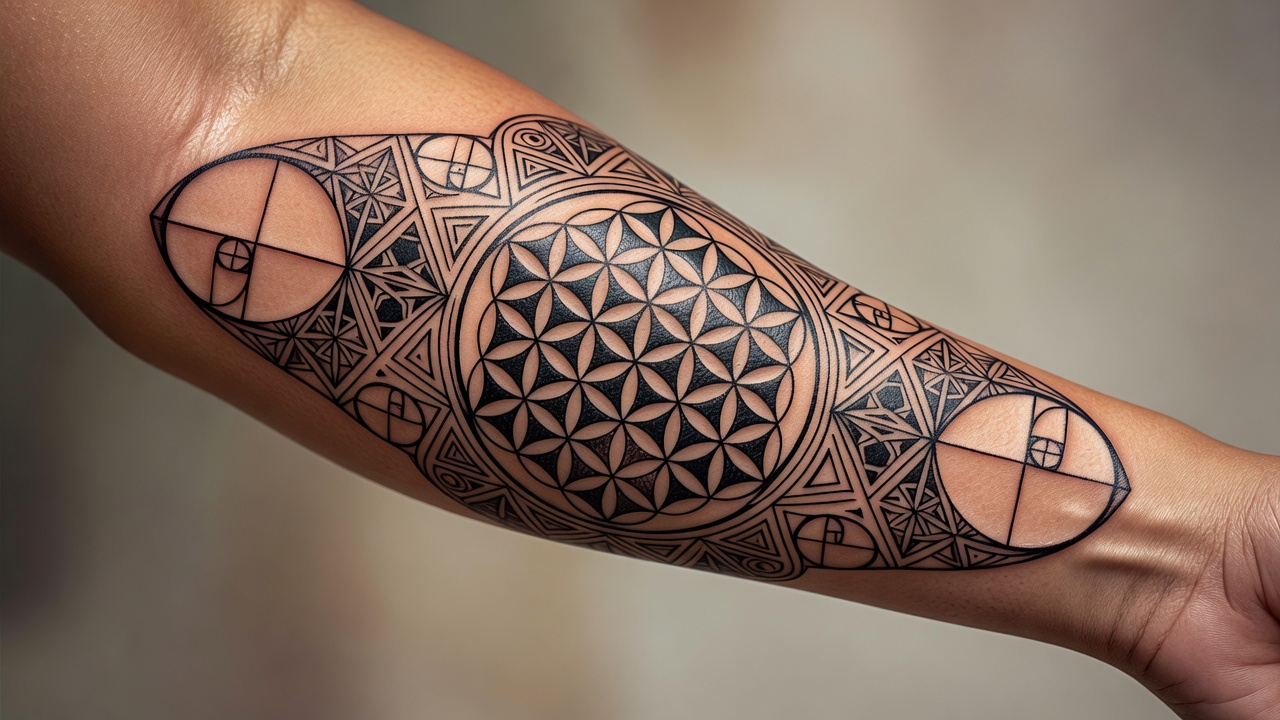
Sacred geometry is not simply a aesthetic choice; it is an ancient linguistic system transcribed onto the human body. Across civilizations, geometric shapes have represented fundamental cosmic orders—from the Flower of Life carved into Egyptian temples to complex Islamic tilework. Today, precision dotwork artists use specialized rotary tattoo machines running at low voltage to lay down individual pigment dots that construct intricate 3D illusions on flesh.
The Mathematical Golden Ratio on Human Anatomy
Unlike a flat canvas, the human body consists of compound curves, muscle bellies, and joint flex points. Applying rigid geometric lines requires an understanding of organic distortion. Master geometric tattooers utilize the Golden Ratio (1.618) to stretch stencils around bicep contours, ensuring that a circle remains optically spherical regardless of whether the arm is flexed or extended.
"When placing a complex Mandala or Platonic Solid on a shoulder, you are not laying down flat geometry; you are warping lines across living topography."
Dotwork vs Line Weight: Stippling Dynamics
Dotwork (or stippling) uses varying dot density to create gradients of shading without solid, heavy black saturation. By controlling needle depth and hand speed, artists can transition smoothly from 100% black density to open negative space. This technique reduces dermal trauma, leading to significantly faster healing times and reduced ink blowouts.
For anyone considering a geometric piece, choosing an artist with a mastery of stencil distortion and needle speed stability is paramount. Sacred geometry demands mathematical perfection—where a single millimeter misalignment can disrupt the symmetry of the entire design.