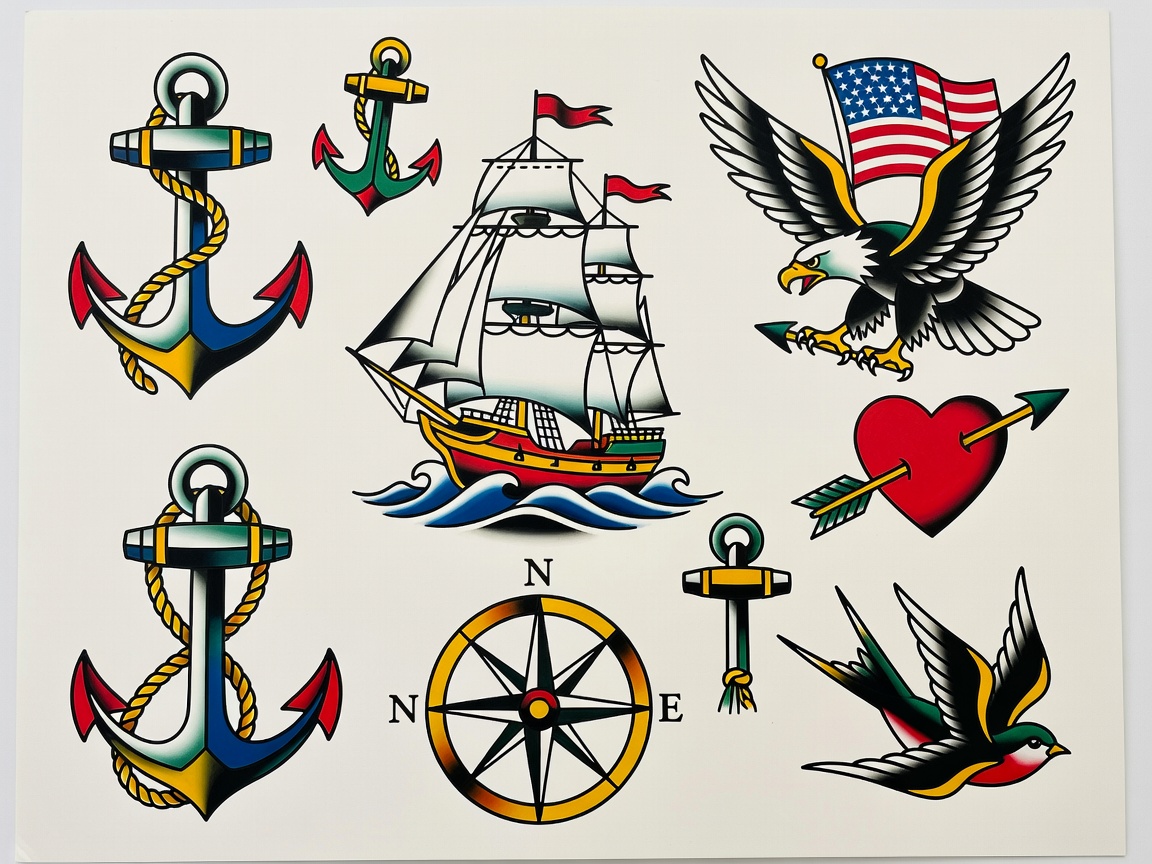
Long before digital stencil printers and fine-needle cartridges, American Traditional tattooing—often called "Old School"—was forged in waterfront parlors, military ports, and carnival side shows. Designed to withstand decades of sun, saltwater, and aging, this movement codified the foundational rule of tattooing: "Bold Will Hold."
The Honolulu Pioneer: Norman "Sailor Jerry" Collins
The undisputed godfather of Western traditional tattooing was Norman Collins, better known as Sailor Jerry. Operating out of Hotel Street in Honolulu, Hawaii during the mid-20th century, Collins combined Japanese shading techniques with rugged American maritime motifs. He formulated custom non-toxic pigments, created needle configurations that penetrated deep into dermal layers, and designed iconic flash sheets that remain industry benchmarks today.
"Good tattoos aren't cheap and cheap tattoos aren't good. Traditional lines exist because skin moves, ages, and sun-fades over thirty years."
Rules of the Craft: Outline, Shade, & Palette
American Traditional follows a strict stylistic discipline:
• Heavy Linework: Thick black outlines drawn with heavy round liners act as physical walls that trap ink pigment inside dermal boundaries over time.
• Restricted Palette: Saturated primary colors—primarily black, crimson red, deep yellow, green, and occasional cobalt blue.
• High Contrast Shading: Black whip-shading transitioning cleanly into open skin (negative space) ensures high readability even from across a room.
Nautical Iconography & Symbolism
Every classical design carried specific meaning for WWII sailors and maritime workers:
• Swallows: Signified 5,000 nautical miles sailed and a guaranteed return home.
• Fully Rigged Ships: Indicated the wearer had navigated the treacherous Cape Horn.
• Anchors: Represented stability, grounding, and safe harbor.
• Daggers through Roses: Symbolized loyalty through adversity and the duality of beauty and mortality.
Decades after its inception, American Traditional remains the most enduring style in tattoo culture—proving that simplicity, structural integrity, and bold lines never go out of style.